Factory Cleaning Programmes for Safer Floors and Budgets
Factory cleaning programmes made simple: safer floors, predictable budgets
Manufacturing does not pause for cleaning, yet clean, safe floors keep people moving and audits on track. When planning is underway, a structured, compliant factory cleaning programme will protect uptime and your budget. Got Dust? Call Us! Visit sweepscrub.com.au to book your free on-site assessment 13004sweep
This guide lays out a turnkey approach used by Sweep Scrub across Adelaide factories and warehouses. It covers the initial deep clean, verticals, routine schedules aligned to shifts and shutdowns, and the safety, environmental and documentation framework that underpins delivery. It also explains how fixed-price quotes are set after a site assessment, so you can forecast with confidence.
What a factory cleaning programme includes
A robust programme starts with a sequenced deep clean, then transitions into predictable maintenance.
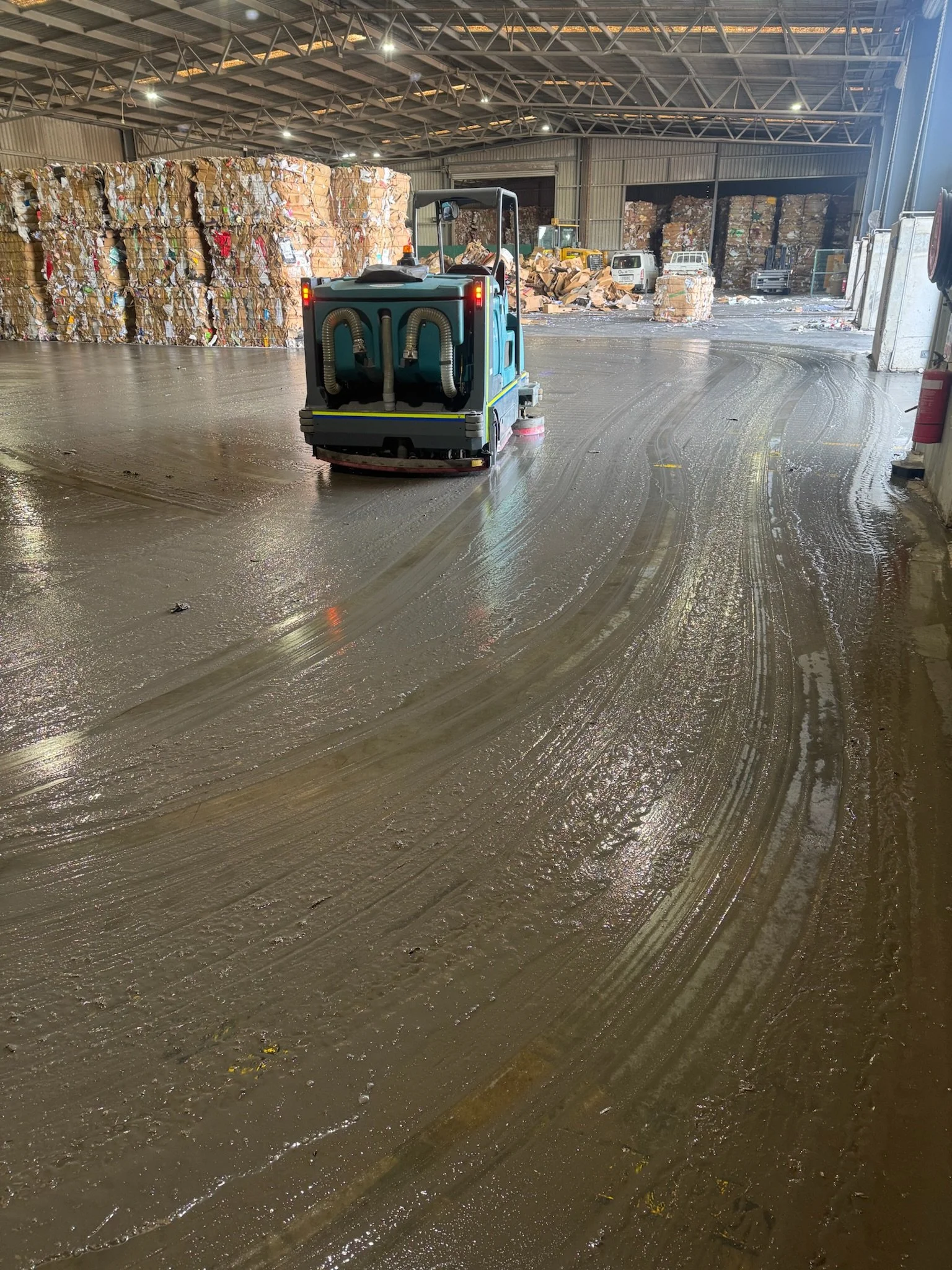
Industrial Scrubbing deep clean with Tennant M30
Industrial sweeping: Mechanical sweepers remove pallet chips, cable ties, shrink-wrap tails and fine dust first to prevent airborne contamination and floor abrasion.
Industrial scrubbing: Detergent-led, single-pass scrubbing lifts oils, tyre polymers and residues. Ride-on units cover large areas efficiently; walk-behind machines reach racked aisles and mezzanines.
Targeted hot-water pressure cleaning: Applied only where needed for baked-on contaminants, trenches, drains and loading zones. Paired with vacuum recovery and holding tanks for compliant wastewater capture.
Edge detailing and spot de-greasing: Column bases, pick faces and dispatch zones receive focused attention.
Walls, ceilings and verticals: Dust and cobweb removal reduces ongoing contamination from above, improving presentation and hygiene.
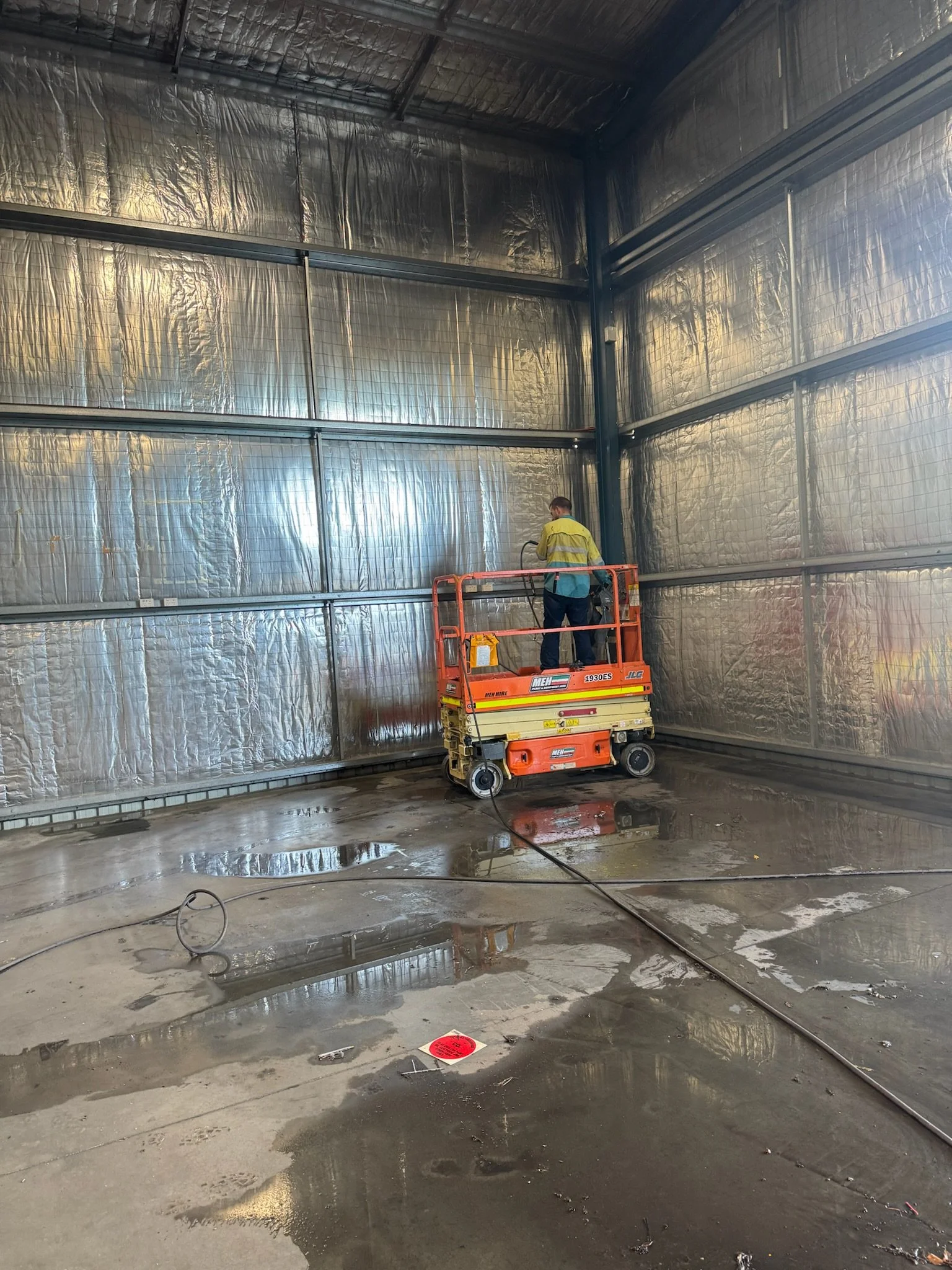
Pressure washing to walls
After the reset, ongoing maintenance locks in results. Frequencies are set by floor area, traffic and risk: for example, weekly sweep and scrub in dispatch and production lanes, monthly vertical dusting in quieter bays, and targeted pressure cleaning each quarter in spill-prone areas.
Building a compliant schedule around production
Cleaning must work around live operations. Sweep Scrub scopes zones and sequences work so production continues safely.
Zoned work areas are isolated with clear signage and cones, maintaining pedestrian lanes and forklift aisle cycles.
Trained spotters coordinate machine movements with shift leads, dispatch and receiving on the client’s radio channel.
Work is staged by shift: high-traffic lanes during changeovers; deep work during planned micro-shutdowns; non-disruptive passes during standard cycles.
After-hours or weekend runs are scheduled when required, including continuous multi-day operations with operator rotation and machine maintenance for sustained output.
This approach supports audits, stocktakes and seasonal resets while avoiding production bottlenecks.
Safety documentation, inductions and licences
Compliance is embedded from mobilisation through handover. Expect the following as standard:
Safe Work Method Statement (SWMS) for all sweeping, scrubbing and pressure-cleaning tasks
Job Safety and Environmental Assessment (JSEA or JSA) for site-specific risks
Site-specific risk assessment and pre-start briefings
Material Safety Data Sheets (MSDS) for all chemicals on site, with PFAS-aware selection where relevant
Site induction compliance through client portals and on-site inductions as required
Police-cleared personnel where stipulated, plus operator training and verification of competency for equipment and access systems
Documentation is issued before works start and updated if conditions change. On completion, wastewater capture, transport and disposal are recorded to support environmental obligations.
Environmental controls and wastewater management
Water is minimised through precision dosing, auto-stop valves and single-pass recovery. Where pressure cleaning is needed, hot-water systems are paired with vacuum pickup and holding tanks. Wastewater and solids are transported and disposed of compliantly, protecting stormwater and supporting audit trails. Targeted pressure, rather than blanket washing, reduces runoff and site flooding risk.
How fixed-price quotes work after a site assessment
Predictable budgets start with a free on-site assessment. Sweep Scrub walks the facility to confirm:
Floor area and access constraints, including tight racking or multi-level zones
Contamination types, from oils and tyre marks to battery residue and food fats
Water and power access, wastewater capture points and disposal requirements
Scheduling needs, including after-hours, weekend or multi-day runs
Documentation, induction and licensing requirements
A defined scope is then issued with a fixed price for the agreed services and schedule. Variables are eliminated up front, so you are not surprised by access limitations, wastewater handling, or compliance costs discovered mid-job. Programmes can be written as single events with follow-on maintenance or as rolling schedules with clear inclusions.
24/7 and weekend delivery, including multi-day operations
When windows are tight, Sweep Scrub delivers after-hours, weekend and continuous multi-day work with crew and machine rotation. Documented handovers maintain safety and output across shifts. This capability is often used ahead of audits, epoxy works and export-loading deadlines.
INDUSTRIAL SWEEPING and INDUSTRIAL SCRUBBING remain the core, with targeted pressure cleaning applied only where it adds value. That mix keeps water use and downtime low while achieving high cleaning efficacy.
Got Dust? Call Us! Visit sweepscrub.com.au to book your free on-site assessment 13004sweep
Short procurement checklist
Use this quick comparator when reviewing providers:
Sequenced method: sweeping first, then scrubbing, then targeted hot-water pressure cleaning with recovery
Documentation supplied: SWMS, JSEA/JSA, site risk assessment, MSDS, induction compliance
Environmental controls: wastewater capture, transport and disposal documented; water-minimising practices in place
Access capability: ride-on and walk-behind machines for tight aisles and multi-level areas
Scheduling: proven delivery around live operations, plus after-hours, weekend and multi-day runs
Quotation: fixed price after on-site assessment with a clear scope and frequency plan
Examples of where this applies locally
Adelaide factories and warehouses often combine high-traffic dispatch lanes with sensitive production zones. A typical H2 plan might deep clean across the whole site, then maintain weekly sweep-scrub passes in lanes and monthly vertical dusting in storage bays. For Port Adelaide sites with seasonal dust, targeted sweeping and scrubbing before EOFY or audits helps keep sensors clean and surfaces safe.
If you are comparing services or planning a pressure cleaning component, learn more about specialist pressure cleaning in Adelaide and how wastewater recovery protects compliance by visiting our pressure washing page. For ongoing site-wide programmes across factories and warehouses, see our Adelaide commercial cleaning services to understand how floor-first methods reduce disruption.
Explore pressure cleaning capabilities and recovery on our pressure cleaning services page: https://sweepscrub.com.au/pressure-washing
Review our broader industrial and commercial offering for factories and warehouses in Adelaide: https://sweepscrub.com.au/commercial-cleaning
Got Dust? Call Us! Book your free on-site assessment 13004sweep
FAQ
What is included in a factory cleaning programme? A sequenced deep clean of floors and verticals: mechanical sweeping, heavy-duty scrubbing, targeted hot-water pressure cleaning with recovery, edge detailing, and walls and ceilings, followed by routine maintenance set to risk and traffic.
How is a compliant schedule built around production? Work is zoned, signposted and coordinated with shift leads; cleaning occurs during changeovers or planned windows, with after-hours or weekend runs when needed, including multi-day operations.
What documentation should you expect? SWMS, JSEA or JSA, a site-specific risk assessment, MSDS for all chemicals, and full site induction compliance and licences where required.
How do fixed-price quotes work after assessment? A free on-site assessment confirms scope, methods, scheduling and environmental controls. The defined scope is then priced at a fixed rate so budgets remain predictable.
Summary and next step
A simple, safe and budget-stable factory cleaning programme follows a proven sequence, aligns to your shifts and shutdowns, and is documented for compliance and environmental control. With fixed-price quotes after a free site assessment, you can plan H2 with confidence and keep production moving. Got Dust? Call Us! Book your free on-site assessment 13004sweep